
.png?width=1125&height=750&name=lost%20love%20again%20by%20Yola%20(1).png)
 Explore LGBTQ+ relationship healing stories focused on reconciliation, trust, commitment, emotional safety and ethical spiritual guidance without guaranteed-result claims.
LGBTQ+ Love Spell Success Stories: Healing, Reconciliation & Commitment
Many people searching for LGBTQ+ love spell success stories are not simply looking for dramatic claims that a ritual “worked.”
They are often asking deeper questions.
Can a relationship recover after emotional distance?
Can two people reconnect after fear, family pressure or a painful breakup?
Can trust return after betrayal?
Can a partner who has become uncertain about commitment become willing to communicate honestly again?
And what should a genuine relationship success story actually look like?
At Lost Love Spells, the healthiest way to discuss spiritual relationship success is not through guarantees of control.
It is through healing, communication, reconciliation, trust, commitment and personal clarity.
Spiritual practices may hold meaning for people who believe in them, but another person's feelings and decisions cannot responsibly be guaranteed.
For that reason, this guide does not present spiritual work as proof that someone can be forced into love.
Instead, it looks at the kinds of relationship journeys people may experience when spiritual reflection is combined with real communication, emotional growth and respect for free will.
The relationship examples below are illustrative composite stories designed to explain common relationship situations. They should not be interpreted as verified individual client testimonials or scientific evidence that a ritual caused a particular outcome.
If actual client stories are ever published, they should be used only with appropriate permission and privacy protection.
If you are currently dealing with separation, emotional distance or uncertainty in your own relationship, you can talk privately with Lady Yola on WhatsApp.
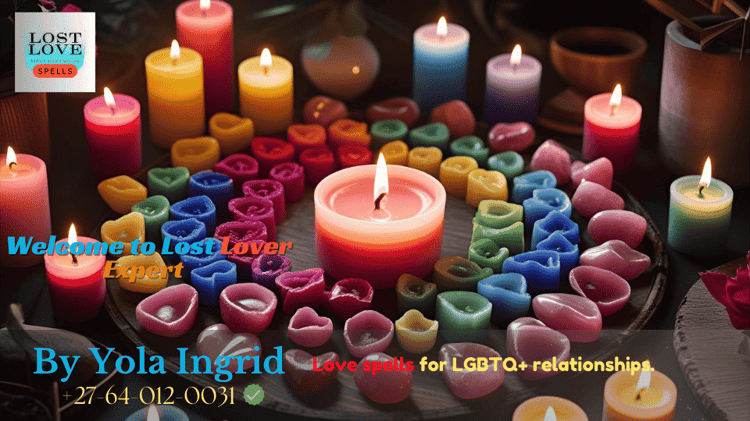
Image: Rainbow candles and rose quartz arranged for an LGBTQ+ love ritual create a striking and meaningful altar that radiates inclusivity, pride, and heartfelt intention. Each rainbow-colored candle represents both the vibrant spectrum of LGBTQ+ identities and the unique individuality of those involved. Lighting these candles during the ritual calls forth energies of diversity, acceptance, and joy, enveloping the space in warmth and positivity. The flicker of each color amplifies the celebration of love in all its beautiful forms.
At the center, rose quartz—widely cherished as the stone of unconditional love—anchors the ritual with its gentle, nurturing energy. Its soft pink hue resonates with compassion, healing, and emotional harmony, helping to deepen trust and connection between partners. Together, the rainbow candles and rose quartz form a powerful combination: the candles invoke visibility and self-expression, while the crystal encourages unity, understanding, and mutual respect.
This arrangement not only empowers the spell’s magical focus—attracting, healing, or strengthening LGBTQ+ relationships—but also acts as a visual affirmation of authenticity and acceptance. It transforms the ritual into both a personal and collective affirmation of love that transcends boundaries and honors the identities of all who are present.
Many people searching for LGBTQ+ love spell success stories are not simply looking for dramatic claims that a ritual “worked.”
They are often asking deeper questions.
Can a relationship recover after emotional distance?
Can two people reconnect after fear, family pressure or a painful breakup?
Can trust return after betrayal?
Can a partner who has become uncertain about commitment become willing to communicate honestly again?
And what should a genuine relationship success story actually look like?
At Lost Love Spells, the healthiest way to discuss spiritual relationship success is not through guarantees of control.
It is through healing, communication, reconciliation, trust, commitment and personal clarity.
Spiritual practices may hold meaning for people who believe in them, but another person's feelings and decisions cannot responsibly be guaranteed.
For that reason, this guide does not present spiritual work as proof that someone can be forced into love.
Instead, it looks at the kinds of relationship journeys people may experience when spiritual reflection is combined with real communication, emotional growth and respect for free will.
The relationship examples below are illustrative composite stories designed to explain common relationship situations. They should not be interpreted as verified individual client testimonials or scientific evidence that a ritual caused a particular outcome.
If actual client stories are ever published, they should be used only with appropriate permission and privacy protection.
If you are currently dealing with separation, emotional distance or uncertainty in your own relationship, you can talk privately with Lady Yola on WhatsApp.
Quick Answer: What Does LGBTQ+ Love Spell Success Actually Mean?
Ethical LGBTQ+ love spell success should not simply mean:
“The person came back.”
A healthier definition of success may include:
- communication reopening;
- conflict becoming calmer;
- emotional healing;
- trust beginning to return;
- both partners choosing reconciliation;
- clearer commitment;
- stronger relationship boundaries;
- greater confidence;
- freedom from desperation;
- or recognising that moving forward is healthier than forcing a reunion.
For couples who value spiritual practice, rituals may provide a framework for reflection, intention, emotional grounding or hope.
But genuine relationship repair still depends on people.
The strongest success story is therefore not:
“Someone lost their free will.”
It is:
“The relationship became healthier, clearer and more mutual.”
LGBTQ+ Relationship Problems Are Still Relationship Problems
LGBTQ+ relationships should not be portrayed as mysterious or fundamentally different from every other romantic relationship.
Couples may struggle with the same issues found in any partnership:
- communication;
- jealousy;
- betrayal;
- emotional distance;
- incompatible expectations;
- commitment uncertainty;
- financial pressure;
- long-distance relationships;
- family disagreements;
- or unresolved resentment.
At the same time, some LGBTQ+ people may also experience outside pressures connected to whether their relationship is accepted, understood or safe to discuss openly.
That experience is not universal.
Every person, family, culture and relationship is different.
A responsible spiritual practitioner should therefore begin with the individual relationship rather than assumptions about someone's identity.
For broader information about relationship-focused spiritual guidance for same-sex and LGBTQ+ couples, see LGBTQ+ Love Spells: Spells for Same-Sex and LGBTQ+ Relationships.
This page serves a different purpose.
It focuses specifically on what healing and successful relationship progress can look like.
Success Story 1: Reconciliation After Emotional Withdrawal
Consider an illustrative couple we will call Maya and Lerato.
They had been together for several years.
The relationship had once felt emotionally secure, but over time communication changed.
One partner felt ignored.
The other felt constantly criticised.
Small disagreements became emotionally exhausting.
Eventually Maya began withdrawing.
Messages became shorter.
Affection decreased.
Lerato responded by asking more questions:
“Are you still in love with me?”
“Why are you acting differently?”
“Is there somebody else?”
The more Lerato demanded reassurance, the more Maya withdrew.
Eventually they separated.
The original request
Someone in Lerato's position might initially search:
“How do I bring my partner back?”
But that is not necessarily the real relationship problem.
The deeper question is:
Why did communication become so difficult that one person felt the need to leave?
A healthier spiritual intention
Instead of focusing on:
“Make her come back.”
a reconciliation-focused intention might centre on:
- emotional calm;
- releasing resentment;
- clearer communication;
- forgiveness;
- and creating space for voluntary reconnection.
What progress might look like
The first positive development might not be an immediate reunion.
It could be that Lerato becomes less anxious.
That emotional calm reduces repeated messages.
After some space, Maya may feel more comfortable communicating.
They might eventually discuss why they became trapped in a cycle of criticism and withdrawal.
If they decide to try again, the success is not simply that Maya returned.
The meaningful progress is that both people now understand:
what broke the relationship and what would need to change.
That is much closer to sustainable reconciliation.
For a wider explanation of this process, see Rekindle Lost Love: Effective Reconciliation Spells Explained.
Success Story 2: Long-Distance Love and Commitment Uncertainty
Imagine another couple, Daniel and Sipho.
Their relationship is loving, but work requires one partner to spend long periods away.
At first they communicate constantly.
Eventually the distance becomes exhausting.
One partner begins asking:
“Where is this relationship actually going?”
The other loves them but avoids conversations about long-term commitment because they are unsure how their careers and locations will fit together.
This creates tension.
Why a binding approach would miss the point
Someone might search for a spell to:
“make my partner commit.”
But forcing commitment does not solve the practical uncertainty.
The real issues may include:
- distance;
- future planning;
- fear;
- communication;
- competing career priorities;
- and uncertainty about what commitment means.
What healthier progress might look like
The spiritual focus may instead centre on clarity and commitment.
The couple begins discussing:
- where they eventually want to live;
- how often they will see one another;
- what exclusivity means;
- whether marriage is a shared goal;
- and what timeline feels realistic.
The relationship becomes stronger because uncertainty is replaced by conversation.
That is a far more meaningful form of commitment than trying to make one person emotionally unable to leave.
Readers whose primary question is commitment can explore Increase Relationship Loyalty and Security with Commitment Spells.
Success Story 3: Rebuilding Trust After Betrayal
Consider Alex and Jordan.
They have been together for several years.
Then Alex discovers messages showing that Jordan had developed an emotional relationship with someone else.
The betrayal may not have become physical, but trust is shattered.
Alex simultaneously wants:
Jordan to stay,
answers,
reassurance,
and emotional distance.
This is a complicated situation.
Returning is not enough
A spiritual website might advertise:
“Bring your partner back immediately.”
But Jordan never physically left.
The relationship problem is trust.
If both partners choose to repair the relationship, meaningful progress might include:
- honesty about what happened;
- ending inappropriate outside involvement;
- clear boundaries;
- accountability;
- emotional healing;
- consistent behaviour;
- and time.
Spiritual support should not erase accountability
A reconciliation ritual should not be used to avoid difficult conversations.
If someone betrayed trust, spiritual explanations should not replace personal responsibility.
The healthier question is:
“Can we rebuild enough safety that this relationship becomes trustworthy again?”
That is different from:
“Can I make this person stay regardless of what happened?”
For deeper reading, see Healing After Betrayal: Spiritual Cleansing and Rebuilding Trust.
Success Story 4: External Pressure Is Affecting the Relationship
Imagine two people who have a strong relationship privately.
But one partner feels unable to discuss the relationship openly with certain relatives.
The other begins interpreting that secrecy as rejection.
They argue repeatedly:
“You are ashamed of me.”
“No, I am afraid of what will happen.”
“You always choose everyone else before us.”
“That isn't what I'm doing.”
Neither person is necessarily wrong about their own emotional experience.
The actual problem may be safety and boundaries
A practitioner should not reduce this to:
“Someone has spiritually blocked your love.”
There may be very real social or family dynamics involved.
The relationship may need:
- clearer boundaries;
- honest discussion about privacy;
- patience;
- agreement about what each partner can realistically handle;
- and decisions about what support they need.
What successful progress may look like
Success does not necessarily mean forcing someone into public disclosure before they feel safe.
It may mean the couple becomes able to discuss their needs without treating fear as lack of love.
One partner learns:
“Privacy does not automatically mean rejection.”
The other learns:
“My partner also needs reassurance that this relationship matters.”
They develop a plan together.
That is relationship repair.
Success Story 5: Reconciliation After a Breakup That Happened Too Quickly
Imagine Chloe and Nadia.
They have a serious argument.
Both say things they regret.
Within hours, one says:
“We're finished.”
They block each other.
Two days later, both feel uncertain about whether the breakup reflects what they really want.
This is different from a relationship that ended after years of unresolved problems.
Timing matters
Immediately sending dozens of messages might make things worse.
A calmer spiritual focus may involve:
- grounding;
- allowing intense emotions to settle;
- examining what caused the argument;
- and creating room for communication.
The first success may simply be a conversation
Perhaps after some time, one person reaches out.
They agree to talk.
Neither pretends the argument never happened.
They discuss:
- what triggered it;
- what each person heard;
- how conflict escalated;
- and what boundaries they need next time.
If the couple decides to reconcile, their success comes from changing how they handle conflict.
Returning to exactly the same pattern would not be meaningful restoration.
Success Story 6: When the Healthiest Outcome Is Not Reconciliation
This story is particularly important.
Imagine Sam has spent months hoping an ex-partner will return.
They search constantly for:
signs,
rituals,
readings,
and reassurance.
The former partner has clearly said:
“I don't want to restart the relationship.”
Initially Sam interprets every coincidence as evidence that the person will eventually change their mind.
Healing changes the goal
Over time, spiritual reflection becomes less about changing the ex and more about Sam's own emotional wellbeing.
They begin:
sleeping better,
checking social media less,
reconnecting with friends,
understanding why the breakup hurt so deeply,
and imagining a future outside that relationship.
Is that failure?
No.
If spiritual practice helps someone move from desperation to peace, that can be a meaningful personal outcome.
Lost-love restoration should never require treating another person's clear decision as meaningless.
Sometimes the healthiest relationship success story is:
“I stopped trying to force an ending to become a beginning.”
Spiritual Success Is Not Always Romantic Reunion
This distinction deserves emphasis.
People searching for success stories often assume there is only one successful outcome:
the person returns.
But spiritual relationship work may lead someone toward several possible outcomes.
| Outcome | Why it can matter |
|---|---|
| Communication resumes | Creates space for clarity |
| Reconciliation occurs | Relationship receives another opportunity |
| Trust improves | Supports sustainable repair |
| Commitment becomes clearer | Reduces uncertainty |
| Conflict decreases | Makes communication healthier |
| Emotional healing occurs | Reduces desperation |
| Boundaries improve | Protects both partners |
| Couple chooses counselling | Adds practical relationship support |
| Person recognises relationship is unhealthy | Creates clarity |
| Closure occurs | Makes moving forward possible |
The outcome should be judged by the quality of the change, not merely whether one specific person remains available.
What Ethical LGBTQ+ Spiritual Relationship Support Should Look Like
A practitioner should not assume that LGBTQ+ clients need fundamentally different magic.
The relationship itself should guide the conversation.
Questions may include:
- What happened?
- How long have you been together?
- Are you separated?
- Do you still communicate?
- Was trust broken?
- Is commitment the main issue?
- Is family pressure affecting the relationship?
- Are you both safe?
- What do you actually want to repair?
- What has your partner said about reconciliation?
Those questions create personalisation.
They are more useful than simply assigning someone a ritual because of their sexual orientation or gender identity.
Identity Should Never Be Treated as a Spiritual Problem
An ethical practitioner should never imply that an LGBTQ+ identity needs:
cleansing,
correction,
removal,
or spiritual punishment.
Relationship spirituality should focus on the relationship issue the client actually brings.
If the problem is betrayal, address betrayal.
If it is communication, address communication.
If it is commitment, address commitment.
If it is heartbreak, address healing.
The person's identity does not need to be “fixed.”
Consent Matters in Every Relationship
The same ethical principles apply regardless of who is in the relationship.
Love does not eliminate autonomy.
A partner can:
say yes,
say no,
ask for space,
choose reconciliation,
change their mind,
or decide that a relationship no longer works for them.
Spiritual practice should not be presented as ownership over that decision.
For a broader discussion of client and relationship ethics, read Legal and Ethical Considerations for Love Spells.
Commitment Is Strongest When It Is Chosen
A person staying because they genuinely choose the relationship is different from someone supposedly being unable to leave.
Healthy commitment may include:
- loyalty;
- shared goals;
- emotional security;
- honesty;
- mutual care;
- and willingness to repair problems.
This applies to every relationship.
Commitment should not require loss of identity or freedom.
Privacy Can Be Especially Important
Relationship consultations often involve sensitive information.
A client may discuss:
- whether relatives know about the relationship;
- marriage problems;
- infidelity;
- private photographs;
- intimate messages;
- family conflict;
- emotional distress;
- or previous relationships.
That information should be handled carefully.
No person should be pressured to reveal more than is reasonably necessary simply because the consultation is spiritual.
For more detail, see Confidentiality in Love Spell Services: What Clients Need to Know.
Success Stories Must Respect Privacy
There is another issue that spiritual websites sometimes overlook:
the privacy of the people appearing in success stories.
A client may be comfortable telling a practitioner what happened.
That does not automatically mean they want their relationship published online.
Before presenting a story as a genuine client testimonial, responsible practice should consider:
- permission;
- anonymity;
- identifying details;
- photographs;
- screenshots;
- names;
- location;
- and whether the other person can be identified.
Removing a name may not be enough if the remaining details clearly identify the couple.
Why Composite Stories Can Be More Ethical
Composite stories combine common relationship patterns without claiming to describe one identifiable client.
That allows an educational article to show how situations may develop without pretending that:
“This exact supernatural result happened to this exact person.”
The examples in this guide are therefore illustrative.
They teach relationship patterns.
They are not evidence of guaranteed spell results.
That distinction strengthens credibility.
Testimonials Should Not Become Guarantees
Suppose a genuine client says:
“My partner and I started communicating again after my consultation.”
Even if that account is authentic, it does not prove:
“Every client will reconcile.”
Personal experiences are individual.
The ethical way to use testimonials is to present them as experiences—not universal predictions.
What Counts as Strong Evidence of Relationship Progress?
When someone is emotionally invested, symbolic signs can feel powerful.
But the strongest indicators are usually practical.
Voluntary communication
The partner chooses to communicate.
Consistent behaviour
Positive change lasts longer than one emotional conversation.
Accountability
People acknowledge what went wrong.
Respect
Boundaries are not repeatedly violated.
Trust repair
Words become supported by actions.
Mutuality
Both people contribute to rebuilding.
Future planning
The couple discusses how the relationship can function differently.
These indicators are far more useful than simply counting dreams, repeating numbers or social-media interactions.
Reconciliation Should Not Mean Returning to the Same Relationship
A common mistake is saying:
“I want everything exactly how it used to be.”
But something about the old relationship led to the breakdown.
If reconciliation occurs, a healthier goal is usually:
not the old relationship restored exactly as it was, but a better relationship built from what was learned.
That may involve:
- different communication;
- clearer expectations;
- stronger boundaries;
- more honesty;
- better conflict management;
- and greater respect.
What If Only One Partner Wants Reconciliation?
This is painful but important.
One person may desperately want the relationship back while the other does not.
Spiritual hope does not remove that difference.
The person seeking reconciliation may still focus on:
- healing;
- clarity;
- communication where welcomed;
- forgiveness;
- personal growth;
- and understanding the breakup.
But another adult's clearly stated boundaries should remain meaningful.
What If Both Partners Want to Reconcile?
When both people still want the relationship, the work becomes different.
The focus may shift toward:
- rebuilding trust;
- changing communication patterns;
- restoring closeness;
- recommitment;
- and preventing the same problems from repeating.
In that case, spiritual practice may complement practical relationship work.
Can Spiritual Work Replace Couples Counselling?
No.
Spiritual guidance and relationship counselling address different areas.
A couple may value:
prayer,
ritual,
traditional practice,
or spiritual reflection
while also benefiting from qualified counselling.
Those approaches do not have to compete.
Counselling may help with:
communication,
betrayal,
trauma,
conflict patterns,
and relationship decision-making.
Spirituality may provide meaning, intention or cultural connection.
Relationship Safety Comes Before Reconciliation
Not every relationship should be restored automatically.
If there is:
violence,
credible threats,
stalking,
serious intimidation,
or coercive control,
personal safety should take priority.
A practitioner should never tell someone that preserving a relationship is spiritually required at the expense of their safety.
In those circumstances, spiritual support may be better centred on:
protection,
healing,
clarity,
or closure.
What Should You Look for in an LGBTQ+-Inclusive Spiritual Practitioner?
A trustworthy practitioner should:
- speak respectfully;
- avoid treating identity as a problem;
- ask about the actual relationship;
- respect privacy;
- avoid stereotypes;
- explain spiritual work clearly;
- respect free will;
- avoid guaranteed-result claims;
- avoid forced-outing pressure;
- recognise safety concerns;
- and allow clients to ask questions.
Inclusivity should be visible in how the person is treated, not merely through rainbow imagery on a website.
Warning Signs in LGBTQ+ Love Spell Services
Be cautious if someone says:
“Your orientation is caused by a curse.”
“I can change who your partner is attracted to.”
“Your partner will lose all free will.”
“You must expose the relationship publicly for the ritual to work.”
“I guarantee permanent obsession.”
“Your partner will return in exactly 24 hours.”
“If you do not pay immediately, your relationship will be destroyed.”
These statements create fear or coercion rather than healthy guidance.
Success Should Improve Emotional Safety
One of the best questions to ask is:
“Do I feel safer and clearer in this relationship than before?”
Emotional safety can include:
- being able to communicate honestly;
- knowing boundaries will be respected;
- not fearing humiliation;
- not needing to constantly monitor your partner;
- being able to disagree without threats;
- and feeling that your needs matter.
A relationship that becomes more controlling is not automatically a spiritual success simply because the couple remains together.
Success Should Improve Communication
Communication is not merely talking more often.
Healthy communication means being able to say:
“I am hurt.”
“I am afraid.”
“I need reassurance.”
“I disagree.”
“I need space.”
“I want to try again.”
“I am not ready yet.”
without every conversation becoming a battle.
Spiritual relationship work should support openness, not silence necessary to maintain control.
Success Should Strengthen Trust
Trust cannot usually be restored by one promise.
It develops through repeated experiences.
A partner says they will call—and calls.
They promise greater honesty—and become more transparent.
They agree to a boundary—and respect it.
They acknowledge an error—and change the behaviour.
That consistency is what makes trust believable again.
Success Should Not Require Obsession
Obsession is sometimes marketed as the ultimate love result.
But healthy attachment still allows people to:
work,
sleep,
maintain friendships,
think independently,
and have personal boundaries.
Someone becoming unable to function without their partner should not automatically be celebrated as proof of “strong love.”
Success Should Leave Room for Individuality
A healthy couple consists of two people.
Commitment does not require losing individuality.
Partners can have:
different interests,
different friends,
different careers,
different emotional styles,
and individual goals
while still choosing each other.
Spiritual relationship work should not require erasing those differences.
What If External Pressure Is the Main Relationship Problem?
If family, social or cultural pressure is affecting the relationship, identify exactly what is happening.
Is someone afraid?
Is there active hostility?
Are financial or housing consequences involved?
Is privacy essential?
Is one partner asking for a level of visibility the other is not ready for?
Those are practical questions.
Spiritual work may help someone feel grounded, but the real-world circumstances still matter.
What If Long-Distance Separation Is the Problem?
Long-distance relationships often struggle with:
communication frequency,
trust,
future planning,
loneliness,
and uncertainty.
The solution is unlikely to be simply increasing attraction.
The couple may need clarity about:
how long the distance will continue,
how often they can meet,
what commitment means,
and whether they are working toward the same future.
What If Jealousy Is the Main Problem?
Jealousy can create a cycle.
One person becomes anxious.
They monitor the other.
The other feels controlled.
They withdraw.
That withdrawal creates more anxiety.
A spiritual approach that promises even greater control may worsen the underlying pattern.
The healthier goal may be:
trust,
confidence,
communication,
and boundaries.
What If the Relationship Has Become Emotionally Cold?
Emotional distance does not always mean someone stopped caring.
It can develop because of:
stress,
unresolved arguments,
work pressure,
resentment,
or feeling repeatedly unheard.
Before assuming someone needs a stronger attraction ritual, ask what changed in the relationship.
Sometimes emotional reconnection begins with understanding the disconnection.
What If the Relationship Has Already Ended?
Start with what the former partner has communicated.
If they are open to talking, reconciliation may still be explored respectfully.
If they have clearly asked for no contact, respect that boundary.
Spiritual work can still focus on:
healing,
clarity,
forgiveness,
and personal recovery.
How to Evaluate an LGBTQ+ Love Spell Success Story Online
Before believing an online success story, ask:
Is the story verifiable?
Does the website explain whether it is a client testimonial, anonymised case example or illustrative story?
Is consent mentioned?
Was the story shared with permission?
Does it guarantee everyone gets the same result?
That is a warning sign.
Is the story unnaturally perfect?
Real relationships usually involve complexity.
Does it acknowledge practical relationship work?
Communication and trust should not disappear from the story.
Does the story respect free will?
Be cautious when “success” means another person became incapable of leaving.
Is the story mainly selling urgency?
If every success story ends with pressure to pay immediately, evaluate it carefully.
What Ethical Success Stories Should Teach
The most useful relationship stories do not merely say:
“The ritual worked.”
They help the reader understand:
- what the problem was;
- what changed;
- what the couple had to address;
- what spiritual work was intended to support;
- what could not be guaranteed;
- and what practical relationship actions mattered.
That transforms testimonials into education rather than pure advertising.
How This Page Fits Into the Lost Love Spells Resource Library
This page should remain the dedicated LGBTQ+ healing and success-story resource.
For broader LGBTQ+ spiritual relationship education, see:
LGBTQ+ Love Spells: Spells for Same-Sex and LGBTQ+ Relationships
For general relationship transformation stories across different circumstances, visit:
Love Spells Success Stories: Transform Your Relationships
For relationship reconciliation:
Rekindle Lost Love: Effective Reconciliation Spells Explained
For long-term commitment:
Increase Relationship Loyalty and Security with Commitment Spells
For privacy:
Confidentiality in Love Spell Services
This separation keeps each resource focused on one clear search intent.
Frequently Asked Questions About LGBTQ+ Love Spell Success Stories
What are LGBTQ+ love spell success stories?
They are accounts or educational examples describing spiritual relationship journeys involving LGBTQ+ couples or individuals. Responsible stories should focus on healing, communication, reconciliation, commitment and personal growth rather than guaranteed control.
Are the stories on this page real client testimonials?
The relationship examples in this guide are illustrative composite scenarios, not presented as verified individual client testimonials. Genuine testimonials should be published only with appropriate permission and privacy safeguards.
Can love spells guarantee an LGBTQ+ partner will return?
No responsible practitioner should guarantee another person's exact future behaviour.
Do LGBTQ+ couples need different love spells?
Not simply because they are LGBTQ+. The actual relationship issue—such as reconciliation, trust, commitment or emotional distance—should determine the spiritual focus.
Can spiritual work help same-sex couples reconcile?
Some people use spiritual practices as part of their personal approach to reconciliation and emotional healing. Whether a relationship is repaired still depends on the people involved and their choices.
Can a spell make my ex change their sexual orientation?
A responsible practitioner should not promise to change another person's sexual orientation or identity.
Can a spell make someone come out?
No ethical practitioner should promise or attempt to force someone into disclosure. Personal safety and readiness matter.
What if my partner is afraid of family rejection?
The situation may require patience, boundaries and realistic discussion about privacy and safety. Spiritual support should not replace those conversations.
What if my partner hides our relationship?
First understand why. Secrecy may involve fear, safety, uncertainty or relationship commitment. The solution depends on the cause.
Can love spells help with commitment?
People may use spiritual practices with intentions around commitment, but commitment is healthiest when voluntarily chosen by both partners.
What if my partner cheated?
Reconciliation after betrayal may require honesty, accountability, boundaries and rebuilding trust in addition to any spiritual work.
Can spiritual support fix jealousy?
Spiritual reflection may help someone feel calmer or more confident, but jealousy may also require communication, boundaries and sometimes counselling.
Can a love spell guarantee marriage?
No. Marriage requires real decisions from both partners.
Can spiritual work help long-distance LGBTQ+ couples?
Spiritual practice may provide emotional or symbolic support, while successful long-distance relationships still require communication, trust and practical future planning.
What if only I want the relationship back?
Your desire for reconciliation matters, but the other person's decision matters too. Spiritual work can also focus on healing and clarity.
What if my ex has asked me not to contact them?
Respect the boundary. Do not use spiritual beliefs as a reason to ignore a clear request for no contact.
Is obsession a successful love spell result?
From an ethical relationship perspective, no. Healthy love allows autonomy, boundaries and emotional stability.
Does staying together prove the relationship is healthy?
No. A healthy relationship also requires respect, communication, trust and emotional safety.
How should I evaluate online success stories?
Look for transparency about whether stories are verified testimonials, anonymous cases, composites or marketing examples. Be cautious of stories used to promise guaranteed outcomes.
Should client names and photographs be published?
Only with appropriate permission and careful attention to privacy.
Can LGBTQ+ clients receive private consultations?
Privacy should be available to any client seeking sensitive relationship guidance. You can discuss your circumstances privately without making the relationship public.
Can spiritual work replace counselling?
No. Spiritual practices and counselling have different purposes and can coexist.
What should I tell Lady Yola in a first message?
You can briefly explain:
- how long you have been together;
- what changed;
- whether you are separated;
- whether communication continues;
- what you hope to repair;
- and any important privacy concerns.
You do not need to choose a ritual name before explaining the relationship.
A Better Definition of Love Spell Success
The strongest relationship success stories are not necessarily the most dramatic.
Success may look like two people having a calm conversation after months of hostility.
It may look like rebuilding trust slowly.
It may mean setting healthier boundaries.
It may mean finally discussing commitment honestly.
It may mean choosing counselling.
It may mean a separated couple deciding to try again.
Or it may mean someone discovering enough self-respect and clarity to stop chasing a relationship that cannot be restored healthily.
Those outcomes may not create sensational headlines.
But they reflect something much more valuable:
relationship progress that respects both people.
Your Relationship Does Not Need to Fit a Stereotype
Every relationship has its own story.
A same-sex couple experiencing betrayal needs betrayal-focused support.
A long-distance couple struggling with commitment needs clarity and planning.
Someone recovering from rejection may need healing.
A couple rebuilding after separation may need reconciliation.
Someone facing family pressure may need boundaries and emotional support.
The spiritual approach should follow the problem.
Not the identity label.
Talk Privately About Your Relationship
If you are dealing with:
a breakup,
emotional distance,
trust problems,
commitment uncertainty,
family pressure,
infidelity,
or reconciliation,
you can begin by explaining what happened.
Lady Yola Ingrid provides private spiritual relationship guidance for adults seeking lost-love restoration, reconciliation and relationship support.
The aim is not to guarantee ownership over another person's choices.
It is to understand your relationship circumstances, identify the spiritual intention you are seeking and approach the situation with greater clarity, privacy and respect.
You can talk privately with Lady Yola on WhatsApp.
You can also contact Lost Love Spells here.
Healthy love is not defined by who can be controlled.
It is defined by whether two people can choose connection with honesty, dignity and mutual respect.
